Course Information

Course Information
Course Title Code Language Type Semester L+U Hour Credits ECTS
Mechanical Systems MEM391 Turkish Compulsory 5. Semester 2 + 1 3.0 5.0
Prerequisite Courses
Course Level Undergraduate
Mode of delivery Face to face
Course Coordinator Doç. Dr. Şenol ŞİRİN
Instructor(s)
Goals The aim of this course is to introduce components of mechanical systems and to realize casting, welding, plastic forming, machining applications.
Course Content Introduce components of mechanical systems and to realize casting, welding, plastic forming, machining applications.
Learning Outcomes
# Öğrenme Kazanımı
1 1. Have basic knowledge about the principles of production methods and their application areas.
2 2. Have knowledge about the advantages, limitations and application areas of production methods compared to each other.
3 3. Have the ability to recognize and select the equipment used in production methods.
Lesson Plan (Weekly Topics)
Week Topics/Applications Method
1. Week Introduction of mechanical production systems Interview, Practice, Other Activities, Presentation (Preparation), Research, Preparation, After Class Study
2. Week Clamp, rasp, point, scribe, hammer, chisel, miter, saw and applications Interview, Practice, Other Activities, Presentation (Preparation), Research, Preparation, After Class Study
3. Week What is rasping? Considerations and rasp applications Interview, Practice, Other Activities, Presentation (Preparation), Research, Preparation, After Class Study
4. Week Sawing rules, maintenance of saws, protection from accidents, cutting with chisel, the need and importance of chiseling, types of chisels, angles of chisels and factors affecting them, chisel tools, chiseling rules, maintenance of chisels, protection from accidents. Interview, Practice, Other Activities, Presentation (Preparation), Research, Preparation, After Class Study
5. Week Used in machining production; introduction of machine tools such as drill, barrel etc. Interview, Practice, Other Activities, Presentation (Preparation), Research, Preparation, After Class Study
6. Week Sharpening of drills and lathe cutting tool. Screw drawing with die and tap. Reaming applications Interview, Practice, Other Activities, Presentation (Preparation), Research, Preparation, After Class Study
7. Week Use of measuring and control instruments. Marking Interview, Practice, Other Activities, Presentation (Preparation), Research, Preparation, After Class Study
8. Week Classification and physical principles of welding methods. Interview, Practice, Other Activities, Presentation (Preparation), Research, Preparation, After Class Study
9. Week Arc welding methods and equipment Interview, Practice, Other Activities, Presentation (Preparation), Research, Preparation, After Class Study
10. Week Arc welding applications. Interview, Practice, Other Activities, Presentation (Preparation), Research, Preparation, After Class Study
11. Week Gas metal arc welding methods and equipment. Interview, Practice, Other Activities, Presentation (Preparation), Research, Preparation, After Class Study
12. Week Gas metal arc welding methods and equipment. Interview, Practice, Other Activities, Presentation (Preparation), Research, Preparation, After Class Study
13. Week Gas metal arc welding applications. Interview, Practice, Other Activities, Presentation (Preparation), Research, Preparation, After Class Study
14. Week Gas metal arc welding applications. Interview, Practice, Other Activities, Presentation (Preparation), Research, Preparation, After Class Study
*Midterm and final exam dates are not specified in the 14-week course operation plan. Midterm and final exam dates are held on the dates specified in the academic calendar with the decision of the University Senate.
The Matrix for Course & Program Learning Outcomes
No Program Requirements Level of Contribution
1 2 3 4 5
1 To gain the ability to apply knowledge of mathematics, science, and engineering in the field of Mechatronics Engineering
2 To gain the ability to design and develop an entire mechatronic system or one of its components under realistic constraints and conditions
3 To gain the ability to identify, model, and solve engineering problems
4 To effectively use up-to-date software and hardware tools with an awareness of project management, risk management, entrepreneurship, innovation, and sustainable development
5 To acquire professional responsibility and ethical awareness
6 To gain the ability to work both individually and as part of a team
7 To gain the ability to communicate effectively in oral and written form, and to use a foreign language efficiently in professional life
8 To gain awareness of the necessity of lifelong learning, the ability to access information, to follow scientific and technological developments, to continuously improve oneself, and to recognize the health, environmental, safety, and legal aspects of engineering practices
Relations with Education Attainment Program Course Competencies
Program Requirements DK1 DK2 DK3
PY1 5 5 5
PY2 4 4 4
PY3 4 4 4
PY4 1 1 1
PY5 1 1 1
PY6 3 3 3
PY7 1 1 1
PY8 1 1 1
Recommended Sources
Ders Kitabı veya Notu Ders Kitabı veya Ders Notu bulunmamaktadır.
Diğer Kaynaklar
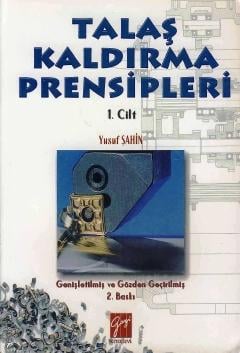
  • 1. Talaş Kaldırma Prensipleri, Yusuf ŞAHİN, Nobel Kitap
  • 2. Kesici Takım Teknolojisi Ders Notları, Prof. Dr. Ulvi ŞEKER
ECTS credits and course workload
ECTS credits and course workload Quantity Duration (Hour) Total Workload (Hour)
Ders İçi
Class Hours 14 3 42
Sınavlar
Midterm 1 1 3 3
Homework 1 14 3 42
Final 1 3 3
Practice 37.5 1 37.5
Total Workload 127.5
*AKTS = (Total Workload) / 25,5 ECTS Credit of the Course 5.0